

Zymtrace Secures $12.2M to Recover Billions in Wasted GPU Spend Through Autonomous Optimization
Venture Guides Leads $8.5M Seed Round for AI Infrastructure Optimization Platform
WILMINGTON, Del., March 11, 2026 (GLOBE NEWSWIRE) -- Zymtrace, a distributed AI infrastructure optimization platform, today announced that it has raised $12.2 million to date to help enterprises uncover hidden performance bottlenecks inside their GPU clusters. The funding includes a newly closed $8.5 million seed round led by Venture Guides, an early-stage investor in cloud infrastructure and AI companies, with participation from Mango Capital, Fly Ventures, and 6 Degrees Capital.
The round also includes strategic angel investors Thomas Wolf, co-founder of Hugging Face; Christian Bach, founder of Netlify; AI systems optimization expert Christopher Fregly; Reece Chowdhry of Concept Ventures, and more.
The company also previously raised an unannounced $3.7 million pre-seed round led by Fly Ventures and Mango Capital, with participation from Entropy Industrial Capital. In the latest financing, Mango Capital and Fly Ventures doubled down on their investment, reinforcing their conviction and support in Zymtrace’s mission.
The new funding will support continued product development, expanded enterprise deployments, and growth of the U.S. go-to-market team, while advancing Zymtrace’s move toward profile-guided autonomous AI workload optimization. The company's Profile Guided AI Optimization approach completes the full agentic optimization loop autonomously, from detecting a GPU bottleneck to opening a pull request with the fix. With MCP integration, customers can wire it directly into their existing pipelines, cutting what once took weeks of manual investigation down to minutes.
The founding team pioneered, open-sourced, and donated the eBPF CPU profiling agent to OpenTelemetry while at Elastic. This technology is now used in production at Cisco, Datadog, Grafana, IBM, and more. At Zymtrace, they are bringing that same engineering excellence to GPUs and AI-accelerated workloads.
Continuous GPU Profiling for Production AI Workloads
As AI adoption increases, infrastructure spending has risen significantly, with the global GPU market expected to reach $326 billion by 2036. Yet, most GPU clusters operate at just 35-40% utilization, wasting billions of dollars in compute capacity.
This inefficiency is a massive economic drain. Underutilized GPUs lead to longer training cycles, costly inference, and wasted energy. When performance bottlenecks arise, identifying the root cause is no simple task. It demands highly specialized expertise and days or weeks of manual investigation across fragmented tools. As a result, many organizations default to a costly stopgap: buying more GPUs.
At the heart of the problem is a lack of fleet-wide, production-grade visibility. Existing solutions are intrusive, fragmented, and blind to the critical interactions between hosts and GPUs. They show utilization percentages. They don't show why.
Zymtrace was built to close that optimization gap. The platform continuously profiles GPU and CPU workloads across distributed systems, correlating cluster-level activity down to individual lines of code. Engineers can trace GPU kernel stalls, memory bottlenecks, or scheduling inefficiencies back to specific CUDA kernels, Python functions, Rust or C++ routines, without requiring code changes.
"The cheapest GPU you can buy is the one you already own," said Israel Ogbole, co-founder and CEO of Zymtrace. "The bottleneck is rarely the hardware. It's the code that runs on it. Every idle GPU cycle is money and energy lost. We are building the autonomous optimization layer for AI infrastructure, improving unit economics with more throughput per GPU, lower cost per inference, and less energy per output."
Customers have used Zymtrace to reduce inference latency and improve GPU throughput while avoiding costly overprovisioning. To cite an example, “before Zymtrace, we spent so much time hunting down why our GPUs were being used inefficiently,” said Ben Carr, co-founder and CTO of Anam. “Zymtrace pinpointed where our workloads were stalling and showed us how to resolve the issues. We improved inference latency by 2.5x and increased throughput by 90% for our Cara3 model.”
Unlike traditional profiling tools that can introduce significant overhead in production environments, Zymtrace uses an eBPF-based architecture designed for continuous introspection with minimal performance impact. The platform generates actionable optimization recommendations across kernel execution and batch sizing, CPU scheduling, and distributed communication, along with estimated cost and performance gains.
Scaling the Next Layer of Efficient AI Infrastructure
As AI infrastructure costs continue to rise, Zymtrace aims to become a critical efficiency layer for enterprises running large-scale AI workloads. Here's what some of the investors backing Zymtrace had to say.
“Zymtrace is creating core technology that will underpin the next generation of AI infrastructure. As infrastructure increasingly becomes the limiting factor to growth, performance gains and efficiency aren’t optional, they’re essential,” said Sage Nye, Partner and Founding Team Member at Venture Guides. “With a strong focus on customers and a clear long-term vision, the Zymtrace team is addressing one of the most significant challenges in GenAI adoption.”
“The future of AI won’t only be defined by who can acquire the most GPUs, but by who gets the most out of them. As compute becomes the dominant cost center, Zymtrace is solving a problem every AI-driven enterprise will face,” said Fredrik Bergenlid, Partner at Fly Ventures.
"Most organizations are still flying blind inside their GPU clusters, unable to see why their most expensive resources are sitting idle," said Robin Vasan, Founder and Managing Partner at Mango Capital. "The teams that can squeeze the most FLOPs from their GPU will have a decisive competitive advantage. That's exactly why we backed Zymtrace from day one."
About Zymtrace
Zymtrace is an AI infrastructure optimization platform that helps enterprises run large-scale AI workloads more efficiently. By continuously profiling GPU and CPU execution across heterogeneous, distributed systems with zero instrumentation, Zymtrace delivers deep visibility into CPU⇄GPU interactions, pinpoints root causes down to the line of code, and uses Profile-Guided AI optimization to help engineers fix bottlenecks and maximize throughput per GPU, per dollar, per watt.
Founded in 2024 and headquartered in Wilmington, DE, Zymtrace is a fully distributed company led by Israel Ogbole, CEO and Co-Founder, and Joel Höner, CTO and Co-Founder. Learn more at www.zymtrace.com or follow the company on LinkedIn.
Media Contact
Maria Bradley
415-509-0498
zymtrace@jmacpr.com
Photos accompanying this announcement are available at:
https://www.globenewswire.com/NewsRoom/AttachmentNg/3e3731a5-abc9-44a7-9a75-bef4c2c162d4
https://www.globenewswire.com/NewsRoom/AttachmentNg/c8e54b93-4d3f-42a5-8279-cfc99dc9cb7f


Zymtrace Co-Founders Israel Ogbole and Joel Höner
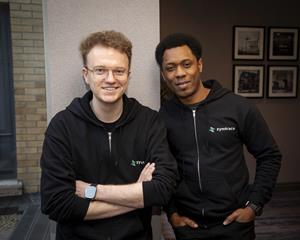
Israel Ogbole, CEO and Co-Founder of Zymtrace (right), with Joel Höner, CTO and Co-Founder of Zymtrace (left). The company announced $12.2 million in funding to help enterprises improve GPU utilization and optimize large-scale AI infrastructure performance.
Zymtrace Team
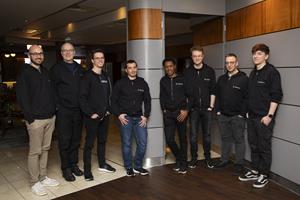
Members of the Zymtrace team. Zymtrace develops an AI infrastructure optimization platform designed to help organizations improve GPU and CPU efficiency across large-scale AI workloads.
Legal Disclaimer:
EIN Presswire provides this news content "as is" without warranty of any kind. We do not accept any responsibility or liability for the accuracy, content, images, videos, licenses, completeness, legality, or reliability of the information contained in this article. If you have any complaints or copyright issues related to this article, kindly contact the author above.
